

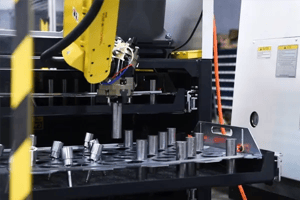
More Productivity. Better Consistency. Greater Capacity.
Modern machine shops face increasing pressure to produce more parts, meet tighter delivery schedules, and maintain quality standards — all while dealing with workforce shortages and rising operating costs.
That's why manufacturers of all sizes are turning to CNC automation and robotic machine tending.
Whether looking to automate a single CNC machine or develop a broader automation strategy, robotic automation can help manufacturers increase machine utilization, improve consistency, and create additional production capacity without adding labor.
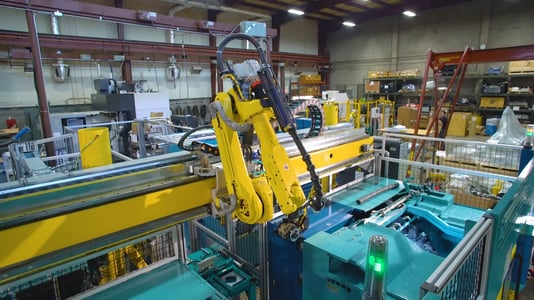
Quick Answer: Why Add Robotic Automation to a CNC Shop?
Manufacturers invest in CNC robotic automation because it helps:
-
Improve machine utilization
-
Enhance part quality and consistency
-
Address labor shortages
-
Decrease operating costs
-
Optimize production more efficiently
When integrated properly, robotic machine tending solutions enable CNC equipment to operate longer, produce more parts, and deliver a measurable return on investment.
1. Increase Machine Utilization and Spindle Time
Every minute a CNC machine sits idle waiting to be loaded or unloaded is lost production time.
To keep machines running, robotic machine tending systems automatically load raw material, unload finished parts, and support continuous production. Since robots perform repetitive handling tasks with speed and consistency, businesses don't have to rely on operators to manually move parts between cycles.
Implementing robotic automation allows manufacturers to maximize spindle uptime, increase throughput, and extract more value from their existing equipment.
Benefits Include:
- Reducing machine idle time
- Increasing parts produced per shift
- Improving equipment utilization
- Gaining greater production capacity without additional machine purchases
2. Reduce Repetitive Machine Tending Work
Loading and unloading CNC machines consume valuable operator time, leaving limited opportunities to perform higher-value responsibilities.
Robotic automation takes over repetitive machine tending tasks, allowing skilled employees to focus on work that requires experience and expertise, such as setup optimization, programming, quality control, and process improvement.
Rather than replacing workers, CNC automation helps manufacturers spend more time on tasks that drive greater value for the business.
Workforce Benefits:
- Reduce manual part handling
- Better use of skilled labor
- Improved employee productivity
- Greater workforce efficiency
3. Improve Part-to-Part Consistency
Consistency is critical in CNC manufacturing.
Manual machining processes are prone to variations, especially in repetitive tasks. A robot performs the same task the same way every cycle, every shift — this repeatability helps reduce part-handling variation, minimize loading errors, and support overall quality objectives.
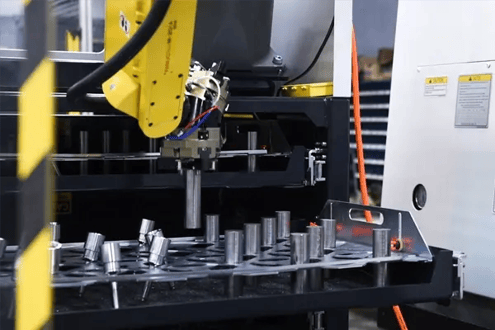 By automating repetitive processes, manufacturers can produce more predictable results and decrease the risk of scrap or rework caused by inconsistent part presentation.
Quality Advantages of CNC Automation
- Repeatable part loading and unloading
- Reduced process variability
- Improved quality control
- Lower scrap and rework rates
- Greater confidence meeting customer demands
The outcome is enhanced reliability throughout the manufacturing operation.
4. Run Attended and Extended Production Hours
One of the biggest advantages of robotic automation is its ability to keep production moving beyond traditional operating hours.
Machine tending robots can support attended operations during regular shifts while also enabling unattended production runs during breaks, shift changes, evenings, or other periods when human involvement is limited.
Productivity Gains:
- Optimizing daily production time
- Increasing machine utilization
- Enhancing throughput from existing equipment
- Supporting lights-out manufacturing initiatives
This increased machine uptime helps manufacturers maximize capacity without extending labor requirements at the same rate.
5. Increase Production Capacity Without Adding Another Machine
When customer demand increases, purchasing additional equipment isn't always the most practical solution. CNC automation can provide another option for manufacturers.
Robotic machine tending can increase the output potential of existing CNC machines by reducing idle time and extending production hours. In some applications, this can help shops take on additional projects before investing in additional equipment.
Capacity Advantages:
- More parts produced with current machinery
- Increased throughput
- Better utilization of existing assets
- Delayed capital equipment expenditure
6. Build a More Flexible, Competitive CNC Operation
Today's manufacturers need to adapt quickly to changing customer requirements, fluctuating production volumes, and evolving market demands.
Modern CNC robotic automation systems can support multiple part types, accommodate new jobs, and scale alongside production requirements. Having this flexibility enables businesses to respond more effectively to opportunities while maintaining efficiency and quality.
Long-Term Business Benefits:
- Support high-mix, low-volume productions
- Improved responsiveness to customer demand
- Easier scalability as business grows
- Stronger long-term competitive advantage
Automation is not simply a productivity tool. It's a strategic business investment that helps build a more resilient and competitive manufacturing operation.
Is Your Manufacturing Factory Ready for Automation?
Many companies are surprised to learn that their production floor is a good candidate for robotic automation.
Your facility may be ready for automation if:
- Machines frequently sit idle between cycles
- Operators spending significant time loading and unloading
- Running production across multiple shifts
- Finding and retaining skilled operators is challenging
- You're seeking to increase throughput without purchasing additional equipment
- You're exploring lights-out or unattended manufacturing
If any of these challenges sound familiar, automation may deliver measurable operational improvements. However, not every CNC process requires the same type of automation, as part size, part weight, cycle time, production volume, and machine type all influence which solution makes the most sense.
Real-World Results: Shops Experiencing Measurable Gains with Automation
Manufacturers across a wide range of industries are integrating robotic automation to enhance productivity, quality, and operational efficiency. By automating machine tending tasks, shop floors can reduce idle time, increase production output, and maximize the performance of existing equipment.
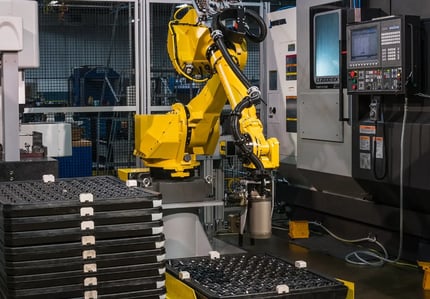 These improvements enable companies to be better positioned to take on new opportunities, respond to customer demand, and scale without increasing overhead. Whether the goal is to extend production hours, overcome workforce challenges, or improve overall competitiveness, CNC automation continues to deliver value for manufacturers seeking to do more.

Ready to Explore CNC Automation?
The right robotic automation solution depends on your machines, parts, production volume, and workflow. Automation Within Reach can help you identify an approach that fits your operation— from standard machine tending to customized automation— without adding complexity. Connect with our team to start discussing your manufacturing process!