


CNC Machine Tending Automation FAQ
Explore by topic


CNC Machine Tending Basics and Common Uses
CNC machine tending automation uses industrial robot(s) to load raw parts, start cycles, and unload finished parts from your CNC machines — minimizing manual handling, increasing consistency, and keeping your spindles, cutting.
Robotic machine tending is a strong fit for lathe and milling workflows where loading/unloading, door/fixture interaction, and part transfer are repeatable.
It works well when machines sit idle waiting for an operator, when off-shift production is limited, or when manual handling affects consistency.
AWR helps you evaluate cycle time, part presentation, and changeover frequency to confirm which product series will deliver meaningful utilization gains for your operation.
It means automation that's practical to buy, deploy, and own without unnecessary complexity.
- Clear progression from standard cells to pre-engineered and fully custom integrations
- Designed for real shop constraints: floor space, staffing, and changing demand
- Focus on repeatable performance and approachable operation for production teams
- AWR helps you avoid over-engineering while meeting throughput goals
- Emphasis on practical deployment, training, and long-term ownership
Machine tending automation reduces the time skilled operators spend on repetitive loading tasks and frees them for higher-value work like setup, inspection, programming, or process improvement.
- Stabilizes throughput when hiring is difficult by keeping machines running consistently
- Helps one operator cover more spindle hours by reducing manual loading constraints
- Supports longer runs through breaks or unattended periods when staging allows
- Improves consistency, reducing rework, and the labor needed to manage variability
Yes — AWR's robotic CNC automation units are designed to make changeovers approachable through repeatable, flexible part handling solutions.
CNC Machine Compatibility, Parts, and Materials
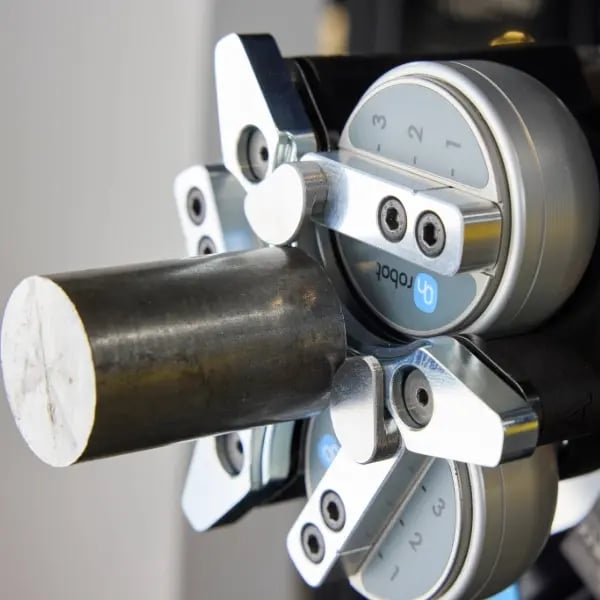
Part capability depends on the AWR machine tending unit and is sized for your application based on payload, reach, end-of-arm tooling (EoAT), and part orientation.
- Key inputs: max. part weight, geometry, grip method (ID/OD vs. workholding), and clearance constraints
- Surface condition (coolant/oil, sharp edges) and required orientation changes
- Material mostly affects handling stability and workholding strategy
Share your heaviest part and tightest clearances, and AWR will match payload and reach to your specific application.
Not always. Many applications can be handled with a flexible gripper approach, modular jaws, or workholding-based handling strategies that cover part families.
- AWR uses a flexible electric part handling solution to accommodate various part sizes, geometries, and materials within a family
- MultiGrip™ jaws enable workholding‑based handling, allowing the robot to grip the vise or palette system rather than the part itself
- Milling pallet options further reduce EOAT changes by standardizing how parts are presented and located from cycle to cycle
CNC Automation Integration and Installation
The timeline depends on which AWR product you choose:
- Flex Series is built as standard, ready-to-deploy robotic machine tending units with no robot programming QuickTouch interface
- Flex-Custom Series is built on the Flex Series base unit with customized features
- Plus Series is 80% pre-engineered cells that leads to around three weeks to install and startup
- Fully custom solutions cover broader workflows and multi-machine integrations, which involve design, build, and testing phases
In many applications, yes — especially with AWR's Plus Series pre-engineered cells, which are built for higher throughput and wider application coverage.
Whether dual-machine tending makes sense for your operation depends on your cycle times, how parts are presented, the robot path required, and how often operators need to access each machine.
Our automation engineers will review your two-machine layout, door access, and part flow to confirm feasibility and define realistic throughput expectations before you commit.
Often, major CNC modifications aren’t required, as most projects focus on safe, reliable interfacing.
-
Typical needs include cycle status/cycle start signals, part presence verification, and safeguarded access
-
Door interaction may be manual or automated, depending on the workflow and safety design
-
Changes required are usually practical additions like interface wiring, sensors, or safe door logic
Footprint and utilities depend on cell type, part presentation, CNC access, and safety clearances.
- Most cells require electrical power and may require compressed air
- Plan for operator access for loading/unloading and maintenance access for the robot and guarding
- Define raw-to-finished part flow to reduce congestion
CNC Automation Safety and Compliance Standards
Operator safety is addressed through a combination of safeguarding, risk assessment, and workflow design.
- Typical measures include physical guarding, defined access points, and presence sensing (e.g., scanners)
- Interlock and controlled stop functions prevent unintended motion during access
- Non-routine work (setup, maintenance, recovery) is designed and trained for — where incidents often occur
- Safety devices and procedures are validated as part of commissioning
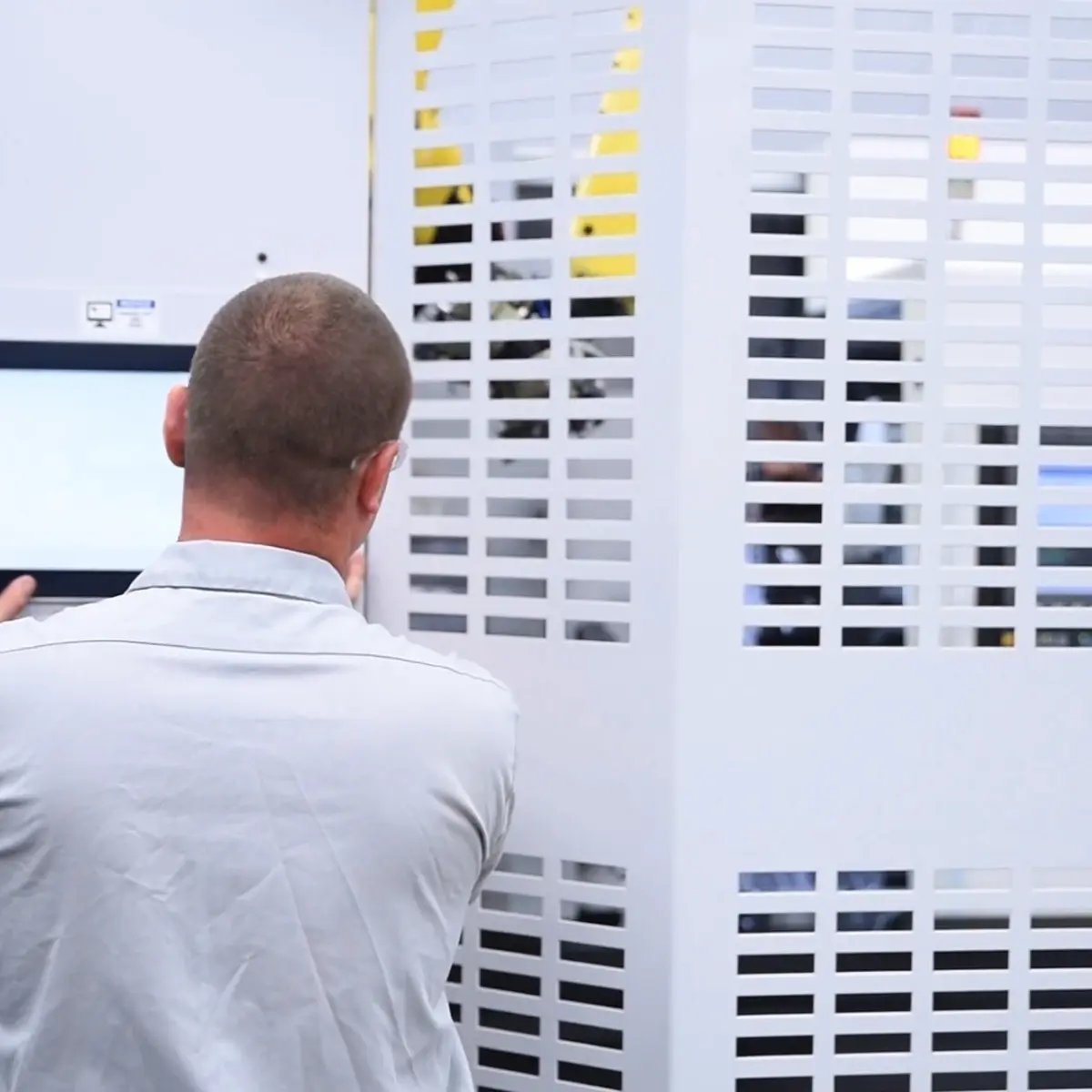
AWR aims to balance protection with usability so operators can access the CNC control and perform necessary tasks without bypassing safety guards.
Training typically includes safe daily operation, predictable recovery, and consistent maintenance across shifts.
- Operators learn staging, selecting programs, recipes, safe access points, and restart protocols
- Maintenance training covers PM routines, EoAT wear items, sensor inspection, and safety device verification
- The depth of training depends on your team's role: add new parts, change EoAT, or expand the cell later
AWR offers training classes throughout the year for its CNC machine tending solutions.
CNC Machine Tending Cost, ROI, and Scalability
Pricing depends on the machine tending solution path and how your parts are presented and handled.
AWR offers a progression from Flex Series standard automation to Flex-Custom enhancements, Plus Series pre-configured cells, and fully Custom Solutions.
Your final cost is influenced by automation type (drawer/rotary/conveyor/pallet), EoAT complexity, any integrated peripherals, etc.
ROI from CNC automation is driven by more spindle hours and reduced waiting time, not by headcount reduction alone.
- Start with current vs. target utilization and quantify idle time caused by manual loading/unloading and breaks
- Include shift coverage gaps, changeover time, scrap/rework tied to handling variation, and labor redeployment value
- Confirm whether part staging capacity supports extended or off-shift runtime
AWR can help model ROI by mapping your current workflow, identifying where the CNC is idle, and estimating the realistic unattended or extended runtime based on part presentation capacity and changeover needs.
Yes. Many manufacturers start with a single automated cell to prove throughput, stability, and operator adoption, then expand to additional machines or more integrated workflows.
- Start with a bottleneck machine or high-impact part family to capture utilization gains fast
- Standardize staging and EoAT strategy early to make future deployments smooth
- Scale through AWR's robotic automation progression: Flex Series → Flex-Custom → Plus Series → Custom Solutions
- Use a roadmap to design the first automation cell for expansion
- Plan success metrics (utilization, throughput, quality) before initial integration
Yes. AWR's Plus Series is designed as a pre-engineered machine tending option that balances standardization with configurable cell choices.
-
A pre-engineered approach can speed implementation because of common features and proven design elements already defined
- Also, reduces engineering time to focus on the custom, application-specific requirements
- Good fit for manufacturers that have outgrown a basic single-machine setup or want a faster path to higher capacity
AWR can help you decide whether a standard machine tending robot, a pre‑engineered cell, or a fully custom automation solution best matches your production variability and growth targets.
Support, Training, and System Lifecycle Ownership
Expect a practical ownership cell supported by preventative maintenance, spare parts planning, and responsive troubleshooting.
- Routine PM inspections of sensors, EoAT wear, and periodic safety checks
- AWR supports adoption with enablement resources, troubleshooting guidance, and training refresh
- Typically, many shops assign daily checks to production and maintenance/engineering teams
Change is normal. The key is designing and planning for adaptability: flexible part presentation, EoAT strategy, and modular interfaces.
- Design for families of parts, not one-off geometries, to minimize rework
- Choose a material handling solution (drawer/rotary/conveyor/pallet) that matches how often your mix and volumes change
- Plan interfaces and safety layouts to accommodate future sensors and peripherals
AWR's product lineup supports the evolution from standard cells to more capable configurations, so you can add features as your mix and capacity needs change.
Choose based on YOUR throughput, safety, variability, and changeover requirements.
- Flex Series: Simplest entry point for one-machine environments and shops seeking a product-based solution
- Flex-Custom Series: Builds on the Flex Series platform when part geometry, machine constraints, or periphertals require tailored features
- Plus Series: Pre-engineered cells for higher capacity or one-to-two machine scenarios
- Custom Solutions: Best when you need multi-machine coordination, advanced peripherals, or end-to-end automated processes
AWR will map your workflow and recommend the smallest-tier solution that meets your requirements and reliably meets your throughput goals.
To receive a fast, accurate recommendation, share a small set of application details:
- Provide CNC make/model and control, part prints or key dimensions, max weight, and material
- Share cycle/TAKT time, workholding, and surface finish requirements
- Describe pain points: idle time, staffing gaps, changeovers, or quality variation
- Include photos/drawings/layouts for the part, access, and safety constraints
Still have questions about your CNC automation application?
Talk with an AWR team member to begin reviewing your CNC machines, parts, and production goals — no obligations or assumptions.
