

SMALL TOWN WITH BIG RESULTS
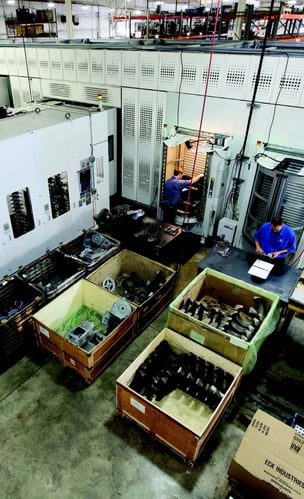
With a population of just over 900, Ottoville, Ohio is a quintessential American small town, self-proclaimed as “A strong community with deep roots in tradition.” While local CNC shop Miller Precision Mfg. Industries, Inc. also has its roots in traditional manufacturing, the company is far from an ordinary job shop. It is, in fact, a full-fledged production facility.
Although comfortably nestled in farm country, the company’s two plants are loaded with advanced technology that many big-city manufacturers would envy. Along with a sea of CNC machines and machining centers are bar-fed Swiss turning operations, robotic welding stations, laser and water cutting, powder coating and a comprehensive fabrication department.
However impressive the sheer volume of equipment maybe, what immediately catches your eye are the various robotically automated work cells.
According to company President Jim Miller, “What first prompted us to move into robotic automation was the difficulty we had in finding enough skilled machine operators as our business grew. We knew we needed more than just a worker who could push a few buttons, we needed people who could learn and use the latest machining technologies. We also dealt with some workpieces that were heavy enough to put a strain on our workers and slowed production.”
Attending trade shows and seminars allowed Miller and his employees to gain a better understanding of robotic automation. One thing that impressed them was the fact that robotic automation isn’t just for high-volume production, but could also make smaller runs more productive and cost-effective, thanks, in part, to quick changeover technology.
Miller’s first foray into automation was in 2009 when he purchased a Flexible Manufacturing System (FMS) designed by Gosiger Cleveland that incorporated an Okuma machining center with a Fanuc robot and a Fastems pallet container system. The FMS exceeded expectations, so in 2012 Miller invested in a second Okuma/Fastems/Gosiger system consisting of four Okuma 500-mm HMCs integrated with a Fastems 56-pallet FMS. Miller uses these systems to machine castings into lift truck transmission housings and industrial pump housings.
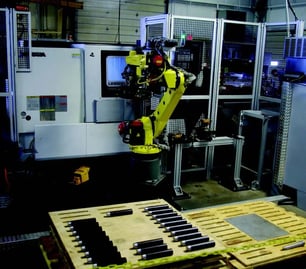
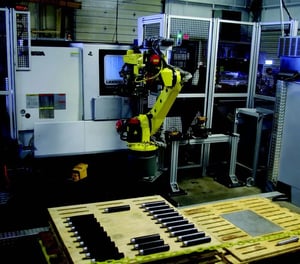
More recently, Miller focused on the turning machine side of his operation and added two more automated work cells. “For the first work cell, we looked at the various families of parts we produce and decided which ones we wanted to put through the cell,” he said. “We chose those parts that have annual volumes of about 1,000 pieces and are run in batches of 250 at a time. We picked two of these part families that could be handled by the same workholding devices.”
A tool rack located within the cell holds the end-of-arm tools (EoAT) to be used by the robot. Each tool has a unique identification marking so the robot can identify the correct tool and, using a quick-change unit, automatically exchange tools as required. To accommodate the various parts, the cell uses two Schunk EoATs: a dual, three-jaw gripper and a dual two-jaw gripper.
There is also a vacuum tool to remove the plywood separation layers. The dualgripper design enables the robot to hold a raw part in one gripper, unload the finished part from the machine with the empty gripper, then rotate and load the raw part into the lathe.
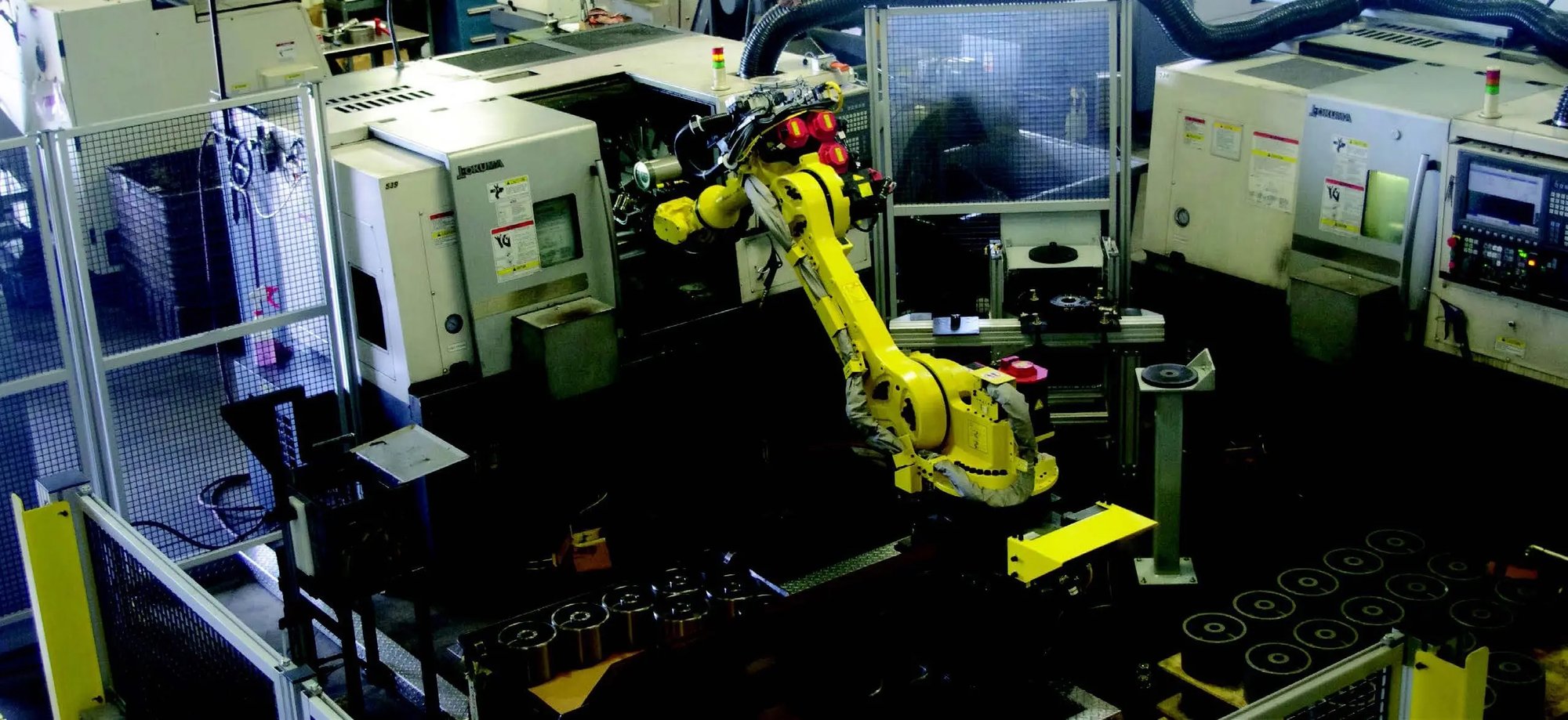
The second cell was designed to deal with a 37-lb. part that the machine operators would rather avoid. The part was being made manually on two Okuma Genos L-400 single-spindle lathes. To automate the process, Gosiger Automation selected a Fanuc R-1000iA/100F six-axis industrial robot with a reach of 2.23 meters and a payload capacity of 100 kgs. These specs mean that the robot arm is capable of handling two parts at a time to optimize throughput.

This cell features an Okuma Spaceturn LB-3000 EX Series, two-axis horizontal lathe and a Fanuc M20iA/35 six-axis industrial robot positioned in front of the machine. The robot is equipped with Fanuc’s 2D iRVision system that enables it to find and identify the correct parts.
Workpieces are positioned for the robot on 42” x 42” wooden pallets placed in a steel locating frame, and with a sheet of plywood between each layer. Another pallet is placed alongside the robot arm to receive finished parts.
Before automating the process, it was a challenge to meet customer delivery dates. Now, in addition to reducing operator touches, improving throughput and eliminating heavy part lifting, Miller can stay ahead of delivery schedules and exceed customer expectations.
According to Jim Miller, “These automated systems not only pay for themselves many times over in improved work flow, they also impress customers who visit our plants.”
“Work cells with robotic automation, multiaxis machine tools, in-process probing for automatic offsets, tool life management and consistent part quality convinces visitors that we’re not a small town job shop, but a full-service manufacturing company.”
“We sent 20 of our 85 people to IMTS this year to see new technologies firsthand,” he continued. “Attending these shows and seminars, finding competent people who can be trained to be automation cell operators and working with dependable equipment providers is what shops like ours need to do to stay competitive.”
Explore Our CNC Automation Solutions
Maximize your CNC potential with AWR's comprehensive machine tending automation. Our automation systems eliminate production bottlenecks across lathe and mill operations, delivering consistent quality and reliability that drive manufacturing success.
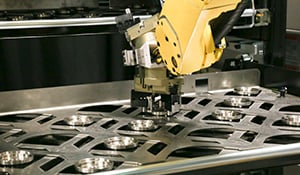
The AWR Flex Series offers standard automation solutions designed to streamline production and reduce costs. Designed specifically for single CNC lathes and mills, our DC, RC, and RCX systems streamline machine loading and unloading operations, minimize costly downtime, and optimize skilled labor utilization—delivering the straightforward implementation and instant productivity gains that drive manufacturing success.
Read More
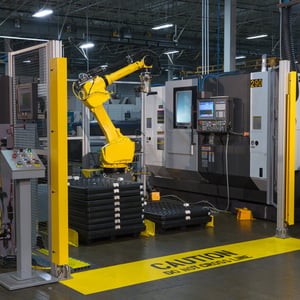
The Plus Series delivers automation without compromise—combining the speed of pre-engineered solutions with the precision of custom applications. Our proven Pallet, Drawer, and Conveyor options provide 80% complete automation foundations, enabling rapid implementation while maintaining the flexibility for specialized end-of-arm tooling that meets exacting manufacturing specifications.
Read More
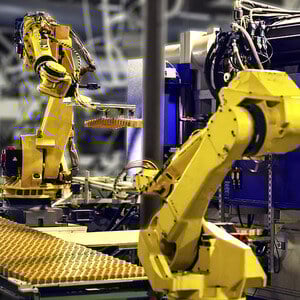
When your production challenges demand solutions beyond standard automation, AWR's Custom Integration Solutions provide the engineering expertise to transform complexity into operational excellence. Our comprehensive approach addresses unique manufacturing requirements through fully tailored systems—designed, built, and tested to optimize multi-step processes and specialized applications—bringing smarter automation within reach.
Read More
