

Robotic Automation


Would Your Company Benefit from Robotic Automation?
Together the benefits of robotic automation can make a shop or factory more productive and profitable. But would it really make that much difference for your business?
Ask yourself these questions:
What is the difference between 100% utilizationof your production capabilities and actual net production? The delta represents lost potential production capacity and revenue.
What is it that prevents you from achieving your true potential production? Why are your machines missing cycles? Typically, many of the answers are labor related. These include operator-paced activities that robots can perform more efficiently and cost-effectively, or manual operations the operator can perform while a robot produces parts without missing precious machine cycles.
Can your operators produce parts 100% of the time and work consistently and error-free throughout the day without fatigue? Not unless they are superhuman and can forego meal times, breaks, restroom visits, preparation, cleanup, and discussions with other employees and managers. Robots, on the other hand, function flawlessly without any of these limitations.
Do one or more of the following scenarios apply to your situation?
- You have CNC machines dedicated to specific parts or parts families (parts that have common sizes and share machine tools and common routings)
- You produce families of parts requiring similar machining processes
- You have weekly or monthly repeat production orders
- Your machining processes are fundamentally stable or controllable
- Your production is limited by operator availability
- Your machine tools are not utilized to their fullest potential
- You have quality issues associated with inconsistent part loading
Are you concerned about any of the following pressures on your bottom line?
- Increasing global competition
- Customer demands for lower prices, better quality, and quick deliveries
- Difficulty in finding qualified labor
- Increasing costs of employee benefits, especially healthcare
- Increasing materials and energy costs
For most companies, the answers to these questions make a strong case for automating at least some aspects of their operations. That’s why from 2009 to 2011 U.S. companies investment in capital equipment and software has increased 31%, while private sector jobs have only increased 1.4%.
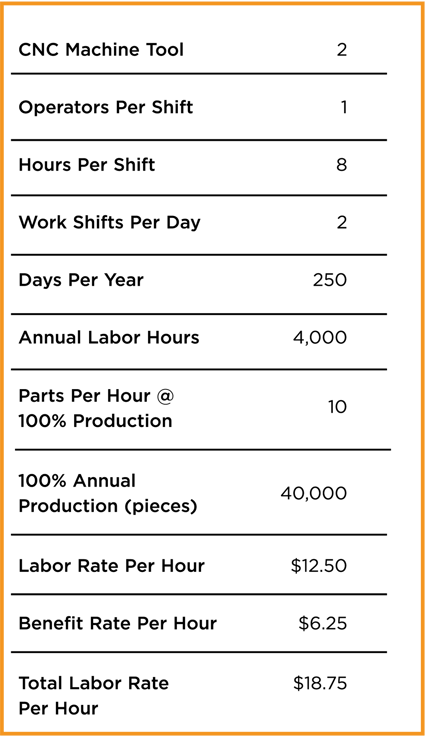
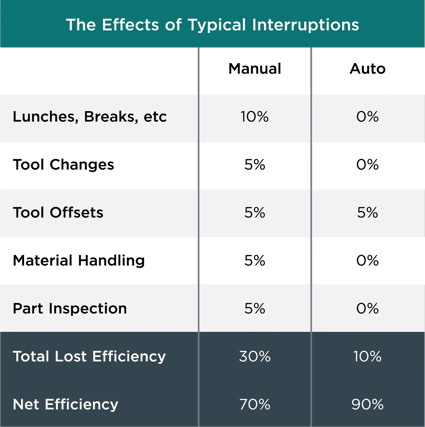
(NOTE: In the above illustration the 10% efficiency loss is due to machine downtime. In the computation below, the loss is20% based on the amount of operator time involved, including material handling and inspection.)
Based on these figures, we see that:
- Operating @ 100% efficiency yields 40,000 pieces
- Manual operation @ 70% efficiency yields 28,000 pieces
- Automated operation @ 90% efficiency yields 36,000 or 8,000 additional pieces
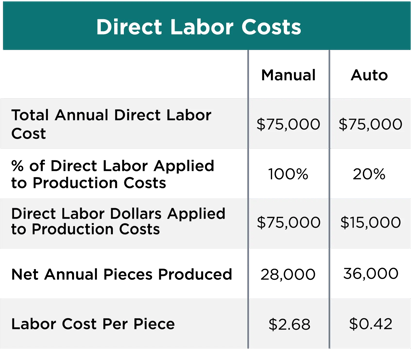
Clearly, automation greatly reduces the cost-per-part. However, automating your process does require significant capital investment, and this cost must be taken into consideration. The following chart shows this in greater detail.
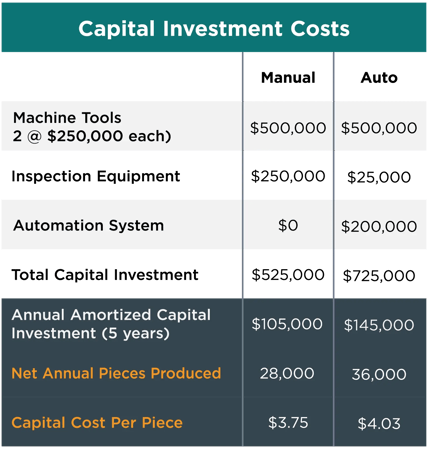
Although the capital expense amount is greater for the automated system during the 5-year amortization period, factoring in the labor savings as illustrated above brings the real costs into focus. Investing in automation reduces the total cost-per-piece produced by 30.9%.
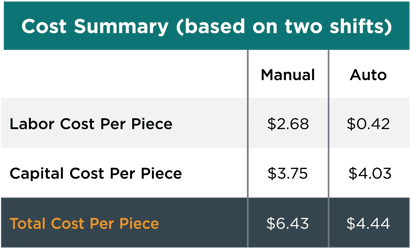
In this scenario in which production increases from 28,000 pieces manually to 36,000 pieces from the automated system, with the $1.99 total cost savings per piece, the overall savings on 36,000 pieces amounts to $71,428.57.
Now consider what your profit would be on the additional 8,000 pieces you can now produce. And, how does this increased production absorb overhead expenses?
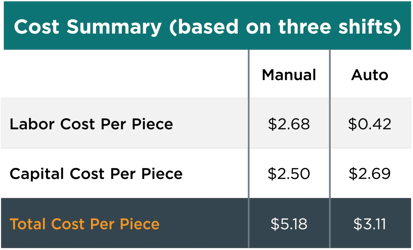
Here’s one more example, based on working 3 shifts to produce 54,000 pieces, which reduces the total cost-per-piece produced by 40%.
Running 3 shifts increases production to 54,000 pieces from the automated system. The $2.07 total cost savings per piece brings the overall savings on 54,000 pieces to $111,780.
Automation in Action
Proven results from manufacturers using machine tending robots to automate CNC mills and lathes in daily production operations. See how manufacturers improve uptime, consistency, and ROI with AWR automation solutions.
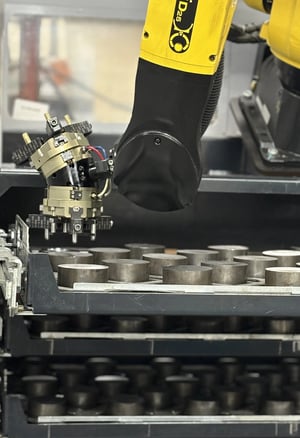
Discover how a Midwest job shop overcame labor challenges and boosted CNC efficiency with AWR's Flex Series DC-2 machine tending unit, achieving significant gains in productivity and uptime.
Read More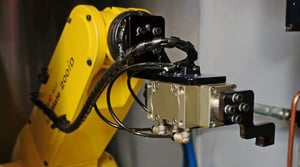
Explore how a custom robotic machining cell streamlined CNC operations and optimized drill station capacity for a leading appliance manufacturer
Read More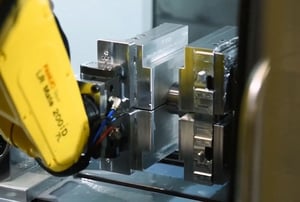
Learn how a CNC shop enhanced its automation strategy by introducing a second robotic cell. Ultimately, streamlining its CNC machine tending and maximizing uptime.
Read More
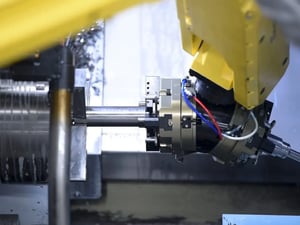
Ready to Explore Robotic Automation?
Boost productivity, reduce downtime, and stay ahead of the competition with CNC automation tailored to your operations. From installation to training and ongoing support, AWR ensures a smooth transition every step of the way.
