

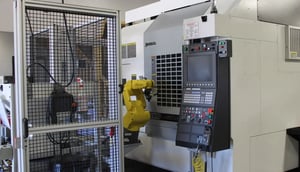
Fast ROI Convinces Versatile CNC Shop to Add Robotic Automation


Rifles and Robots
As Cody explains, “If we get a job that requires a process we don’t normally do, we have very few shops in the area we can call on, so we figure out how to do it ourselves. This often means adding new technology.”
“In addition to several VMCs for precision machining, we also do fine blanking, surface grinding, turning, deburring, and even wire EDM. In fact, for many years, we had the only wire EDM in the state. Those aren’t the capabilities you typically expect to find in a 15-person shop.”
In business since 1980, Glacier Tool & Die co-founder Gary Dolce was an early adopter of CNC machining and, upon learning that the U.S. government was seeking defense contractors to manufacture parts for the M16 rifle, decided to pursue the contract. He bought an AR-15 rifle (the non-military predecessor to the M16), dismantled it, and decided which parts he could make. He won the contract, and Glacier instantly evolved from a tool and die shop into a CNC production facility.
Recently, the company won a defense contract to make the trigger/hammer assembly for the M16. The contract was for 65,000 pieces with the possibility that the order could increase in volume. Within the first year, the order increased to 485,000 pieces.
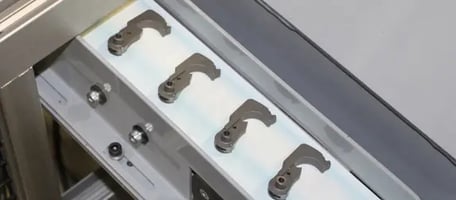
Although they had built a number of custom fixtures and production was running smoothly, the increased demand concerned Cody: “The additional volume placed a heavy demand on the equipment and our employees. It required two dedicated VMCs and three employees over two shifts. I quickly realized we needed to find a way to meet production demands, make it easier on the operators, and reduce the overall cost-per-part.”
That’s when they decided to explore automating the process with a Fanuc robot they previously purchased but had yet to use. “After we bought the robot we couldn’t find anyone locally who could integrate it for us, so it never came off the skid. Knowing that we had a solid order for these parts through 2019, we decided to take another look at automation.
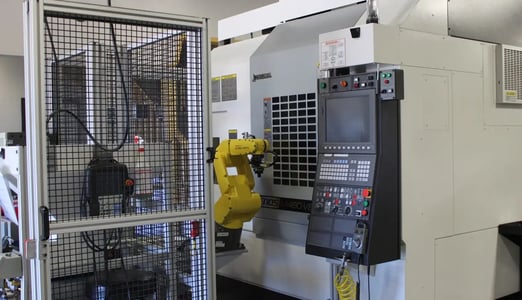
That’s when we contacted Okuma dealer Hartwig, Inc. They recommended that we upgrade to an Okuma Genos M-460 CNC vertical machining center that had the performance specs we needed and could be tended by the Fanuc robot. Hartwig explained that Gosiger Automation in Dayton, Ohio, was the systems integrator for all US Okuma dealers and would work with us to design an automated loading and unloading system.”
According to Peggy Dolce, “A big plus was that Gosiger was willing to integrate the Fanuc robot and a Flexomation part feeder that we also owned into the system. Other companies we talked to didn’t want to use our existing equipment.”
“It also helped that Gosiger is an Okuma distributor and authorized Fanuc integration partner, so they already knew the machine tool, robot and operating system, which made integrating the robot much easier.”
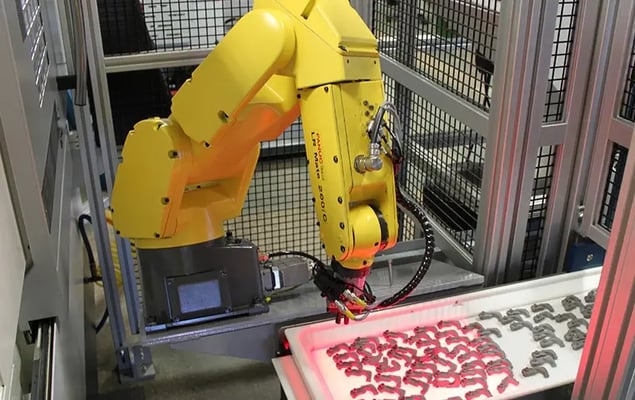
Gosiger Automation’s solution was to mount the Fanuc LR Mate 200iC, 6-axis industrial robot, onto a fabricated steel base positioned to the side of the machine door so it can reach around to load and unload parts.
Equipped with iRVison, the robot identifies and picks acceptably oriented parts from the feeder, and corrects for radial orientation to enable fixture loading.
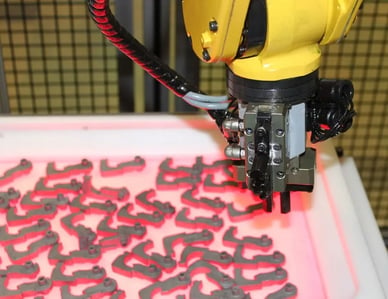
In operation, parts are loaded into the system in bulk, where the Fanuc iRVision visual detection system is used to eliminate the need for parts to be precisely located for robotic handling. The parts are placed into fixtures designed and built by Cody at Glacier Tool & Die, with input from Gosiger Automation that ensured they were automation-friendly. In each machine cycle, there are three sequential part machining operations performed. The robot indexes the parts through the nests, loading a blank and unloading a finished part after each machine cycle, and depositing the finished parts onto a conveyor belt. Parts are handled efficiently by a Schunk component-based, dual-gripper, end-of-arm tool.
When they originally bought the robot, Gary and Cody thought using it would be as easy as plug-andplay. Cody found out otherwise when he attended a Fanuc robot programming workshop.
“It’s not just a matter of telling the robot to do something,
it also needs to communicate with the other parts of the cell.
Gosiger Automation handled all of that so we could get up to speed fast.”
Ready to Explore Your Robotic Automation Options?
Discover how robotic machine tending solutions help manufacturers increase capacity, reduce labor constraints, and achieve a fast return on investment.
Discover the factors that impact automation payback and learn how manufacturers justify robotic machine tending investments.
Explore Automation ROI
Read how manufacturers are overcoming labor challenges, increasing throughput, and achieving measurable results with automation.
Browse Sucess Stories
Review AWR's robotic automation offerings to find which solution best fits your machines, parts, and production requirements.
Compare Solutions