Skip to content
AWR_TEXTURE_3-1

Lights-Out Manufacturing

The prospect of making parts overnight with little or no labor cost is extremely tempting to any CNC machine shop. It’s easy to understand why: Competition is keen and customers demand better parts and products to be available precisely when they need them - and at the lowest possible price.

Modern Technology Makes It Possible

The idea that a manufacturer can turn off the lights and go home every night while unattended mechanical minions crank out  parts is an intriguing concept.

The big picture objective of lights out is to reduce labor costs, but there are other potential savings as well:

  • Long overnight runs can make your daylight machine time more flexible,  so you can make more short runs that require changeovers, work on more complicated parts, or respond to an urgent order from one of your customers.
  • Machine operators can use their time more efficiently by setting up  overnight production while daytime runs are in progress.
  • Power companies often charge less for energy used during off hours (overnight), so it may cost less to operate machinery during lights-out production.

Considerations

Assuming the kinds of parts you want to produce during lights out manufacturing lend themselves to unattended operation, there are some fundamental issues to consider.

Reliability of Equipment. Since there won’t be anyone on site to address machinery malfunctions, the machine tools, peripherals and automation equipment you use must operate flawlessly.

Machine Tools. Is the machine capable of continuous operation? Is it highly stable and rigid? Does it have appropriate spindle power? Does it have enough tooling stations to automatically provide an adequate supply of cutting tools?

Is the control system capable of monitoring activities and either auto-correcting or remotely communicating problems? Does it have built-in thermal compensation and crash avoidance technology?

Chip & Coolant Management. Can the chip conveyor adequately handle the quantity and types of chips produced throughout the production run? Or will the chips begin to back up and create problems? Can the conveyor efficiently filter coolant to prevent fines from contaminating the cutting fluid and potentially clogging coolant delivery nozzles or causing a pump breakdown? If high-pressure coolant delivery is required, can the delivery system be programmed to vary the pressure throughout the machining cycle as necessary?

Material Loading/Unloading. The two most common loading methods are bar feeders for loading bar stock, and robots for just about everything else.

If loading bar stock, is the feeder capable of holding an adequate amount of material in its magazine or holding tray? Does it have the ability to continuously feed and support bar stock in synch with the machine tool to eliminate crashes? If running a family of parts, can it communicate with the machine tool program schedule and automatically adjust itself to a new part? Is it sturdy enough for continuous operation? Once the cycle is completed, can the part simply be pushed out of the machine tool into a bin? Is a vacuum unloader required to help protect part finish? Is a robotic arm or other device called for to unload the machine tool?

Planned Preventative Maintenance. Although such a program is invaluable regardless of whether or not you perform lights-out manufacturing, it’s extremely critical for overnight operation. If a machine goes down at any time it’s a problem, but if machine operators are present, they can shift production schedules or use other machines until help arrives.

When a machine breaks down in the middle of a lights-out shift, work grinds to a halt and precious run time is lost until someone is available to correct the problem. Whether you create an in-house plan or contract with a reliable service provider, a preventative maintenance program is critical for lights-out operations.

Remote Monitoring. Although using reliable equipment and following a planned preventative maintenance program will minimize problems, there is always the possibility of machine failure, cutting tool breakage, power outages, and other unexpected issues.

That’s when having a remote monitoring system is invaluable. Today many CNC machine controllers and peripheral equipment are designed to work with Ethernet or other communications tools that can send alerts to PCs or mobile devices located anywhere you choose. A number of manufacturers use MTConnect® for universal connectivity. It is, essentially, a common translator based on Internet standards that enables CNC and non-CNC machine tools and other shop floor equipment to communicate with each other and with a central production monitoring system.

Commitment. For lights-out production to work, everyone must be on board, from management and the machine operators to the support staff. It’s a cultural change for many companies and change always carries with it an element of fear. So it’s critical to make certain everyone in the organization understands the plan, their roles in it, and what it means for their future and that of the company.

The Role of Robotics

As mentioned above, robots are commonly used to load and unload a variety of parts during lights out production. Robotic technology continues to advance and capabilities currently include a number of other functions.

Using vision systems, robots can sort parts by size, color and by reading bar codes on the parts. Programming robots has become easier, as has integrating the robotics with “smart” machine tool controls, such as Okuma’s OSP. In the near future it is expected that some robots will be programmable via voice commands.
AWR-WHITEPAPER-LIGHTSOUTMANUFACTURING-01

Whether used for lights-out or daytime production, robotic-based automation has enormous potential to reduce labor costs, improve capital utilization, improve quality and increase productivity for companies of all sizes. Yet, it is estimated that in the U.S. robots are used in fewer than 10% of potential applications. This means there is great potential for manufacturers to leapfrog their competition through robotic-based automation

Not every application lends itself to lights-out manufacturing. Some parts are simply too complex too successfully manage without operator intervention.

Here are some considerations for evaluating applications for automation:

  • Machine tools & fixturing are automation capable
  • Machine tools are dedicated to specific parts or parts families
  • Families of parts share common machining processes
  • Customers issue repeat orders
  • Machining processes are stable or controllable
  • Production is slowed by operator intervention
  • Machine tools are not fully utilized
  • Part quality is inconsistent due to operator influence

The most adaptable CNC machines for lights-out production are grinders, horizontal and vertical machining centers, multi-function lathes and 2 & 4 axis lathes. To ensure the system holds accuracies throughout the lights-out period, many manufacturers use process control devices appropriate to the machine tools and applications. These may include jump-on gages, probes mounted in the machine tool, CMM (Coordinate Measuring Machines), and standard or custom automatic gaging systems.

Case Studies

Following are case studies of lights-out installations developed by Gosiger Automation. As these examples demonstrate, lights-out automation is not only feasible but, with the right equipment and consultation, can open up many new avenues of income and profitability for companies from job shops to major manufacturers.

Automated Grinding Cell

For this manufacturer of rotors used in air compressors, Gosiger Automation incorporated an Okuma GA-47 grinder with a FANUC robot equipped with a vision system and adjustable grippers.

The Okuma grinder has a flexible, 2-axis configuration for greater versatility and handles parts up to 60” long, weighing as much as 660 lbs.

A specially designed chuck and adjustable grippers on the FANUC single arm robot enable the cell to accommodate a variety of part sizes weighing up to 420 pounds. An integrated gauging system uses a probe to determine  when to automatically adjust the grinder during the operation to assure part accuracy and consistency.

The cell also includes a custom conveyor system that utilizes pallets of unfinished parts loaded onto the conveyor by a forklift.

Another pallet receives the finished parts from the robot arm and, when completely loaded, is indexed out of the cell by the incoming pallet of unfinished parts. As a result, the cycle time for the operation is reduced by 62%, from the original time of 45 minutes to just 16.8 minutes and runs unattended overnight.

Watch the video:

Vision System Lets Robot “See” During Lights-Out Operation

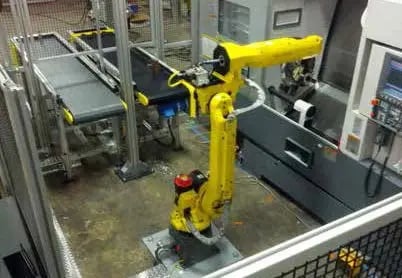
Gosiger Automation combined an Okuma Multus B-300 CNC machining center, with a Fanuc M-20iA six-axis industrial robot, and a fixtureless conveyor system.

Steel slugs to be machined sit on the incoming conveyor and the robot uses a vision system to locate and then pick up and load the parts into the machining center. At the end of the cycle, the robot arm removes the part and places it on the outgoing conveyor. As the Okuma lathe machines a part, the Fanuc robot uses its IRVision system to locate and pick up the next raw blank from the inbound parts conveyor for processing.

The lathe’s end of cycle signal queues the robot to open the machine door, load a part blank in the lathe’s sub-spindle, unload the finished part from the main spindle, close the machine door and initiate a machine cycle start command.

For optimum efficiency the finished part is deposited on the outbound conveyor by the robot as the machine tool produces a new part, and the next raw blank is picked up and staged.

Watch the video:

For the right lights out plan, equipment selection, installation, training and customer support, turn to Gosiger Automation, now Automation Within Reach. With over 90 years of machine tool experience, and with hundreds of successful automation installations, Automation Within Reach brings unmatched experience and expertise to manufacturers of all sizes.

Boost Efficiency with Robotic Machine Tending

Learn proven strategies to streamline your CNC operations, reduce labor costs, and maximize machine uptime. Discover how automation can transform your shop floor—and connect with our team today to start building a smarter, more productive future.