


Skip to content
AWR_TEXTURE_3-1

Lights-Out Manufacturing

Thank you for your interest in lights-out manufacturing.

You'll receive an email shortly with a copy of the whitepaper, or you can continue reading below.

 Manufacturers are constantly looking for ways to increase productivity, improve machine utilization, and remain competitive in a demanding market. Lights-out manufacturing offers an opportunity to maximize production capacity by allowing machines to continue making parts during unattended hours, helping manufacturers generate more output from existing equipment.

The concept of running production after operators leave for the day is no longer limited to large manufacturers. Today’s CNC machine tools, robotics, monitoring systems, and automation technologies make unattended production more practical and attainable than ever before. While reducing labor costs remains a benefit, lights-out manufacturing can also help manufacturers:

  • Increase machine utilization beyond traditional operating hours
  • Create additional production capacity without adding equipment
  • Free operators to focus on setup, programming, quality control, and other higher-value activities
  • Improve flexibility for short-run jobs, changeovers, and urgent operational needs

What to Consider Before Running CNC Equipment Unattended

 Not every part, machine, or process is suitable for lights-out manufacturing. Before implementing unattended production, manufacturers should evaluate the reliability of their equipment, material handling, machining process, maintenance program, monitoring capabilities, and workforce readiness. 

Equipment Reliability Comes First

 When operators are not on-site to address unexpected issues immediately, machine tools, automation equipment, and supporting technologies must perform reliably throughout the production run.

A lights-out system should be designed around predictable, repeatable operation and include appropriate safeguards for common failure conditions. 

CNC Machine Readiness

The ability to run unattended varies by machine, and several factors should be considered:

  • Is the machine capable of extended or continuous operation?
  • Does it offer the stability or rigidity required for long production runs?
  • Is there sufficient tooling capacity to support unattended machining?
  • Can the control system monitor activity and communicate issues remotely?
  • Does it include thermal compensation and collision avoidance technologies?

The goal is not simply to keep the machine running. The entire machining process must be stable enough to produce consistent parts over an extended period without constant operator intervention.

Plan for Chip and Coolant Management

Chip and coolant management can become especially important during extended unattended production.

Manufacturers should determine whether chip conveyors can handle the quantity and types of chips generated throughout the production run. Chip buildup can interfere with machining, coolant flow, and equipment operation.

Coolant management should also be evaluated. Filtration may be necessary to prevent fines from contaminating the cutting fluid, clogging coolant delivery nozzles, or causing pump problems. Applications requiring high-pressure coolant should also consider whether pressure can be automatically adjusted throughout the machining cycle.  

Automate Material Loading and Unloading

Material handling is one of the most important considerations for lights-out CNC production.

Bar feeders are commonly used for bar stock applications, while robotic machine tending offers a flexible solution for loading and unloading a wide range of individual parts.

For bar-feed applications, consider:

  • Does the feeder hold enough material for the planned production run?

  • Can it continuously feed and support the bar stock while the machine tool operates?

  • Can it accommodate different part programs or part families?

  • Can completed parts be discharged automatically?

  • Is secondary equipment required for unloading or downstream operations?

For robotic machine tending, manufacturers should similarly measure robot reach, payload, gripping, part presentation, workholding, cycle time, and the material required for the intended unattended run.

Establish a Preventive Maintenance Plan

Preventive maintenance is important for any CNC operation, but it becomes critical when machines are expected to operate unmanned.

During staffed production, machinists often recognize a developing issue and respond quickly. During a lights-out shift, a machine failure can halt production completely until someone is available to diagnose and correct the problem.

A planned preventive maintenance strategy helps minimize unplanned downtime and support more reliable unattended operation. Businesses can manage maintenance internally or work with a service provider, depending on their resources and equipment requirements.

Use Remote Monitoring and Visibility

Even with reliable equipment and a strong maintenance strategy, unexpected problems can still occur. Machine failures, cutting tool issues, power interruptions, and other events can bring unattended production to a stop.

Remote monitoring can help manufacturers identify these issues in advance by providing machine status information and alerts.

Modern CNC controls and peripheral equipment can communicate over Ethernet and other networks, enabling remote access to operational data and alerts. MTConnect® is also used by many manufacturers to provide standardized connectivity between CNC and non-CNC equipment and production monitoring systems. Ultimately, providing manufacturers with greater awareness of what is happening when there are no workers on the shop floor.

Prepare Your Workforce for the Transition

Successful lights-out manufacturing requires more than reliable equipment. It also requires organizational commitment.

Management, operators, maintenance staff, programmers, and other support workers should understand why automation is being implemented, how the system will operate, what their responsibilities will be, and how their roles may change.

For many manufacturers, automation alters how people interact with production rather than simply removing people from the process. Operators can spend less time repetitively loading and unloading parts and more time on setup, quality, and other higher-value tasks.

The Role of Robotics in Lights-Out Manufacturing

Robots are commonly used in lights-out manufacturing to automate the loading and unloading of CNC machines. Modern robotic systems can also support additional material-handling, inspection, sorting, and process-automation tasks.

Vision systems, for example, allow robots to locate and identify parts based on their position, size, features, or other characteristics. Robots can also integrate with CNC controls and other automation equipment to coordinate machine cycles and material movement.

As robotic technology and programming tools continue to become more accessible, manufacturers have more options for implementing automated machine tending without requiring extensive in-house robotics expertise.

Whether used for lights-out or daytime production, robotic automation can help manufacturers improve machine utilization, increase throughput, enhance part-to-part consistency, create more efficient workflows, and reallocate labor resources. Manufacturers embracing automation often gain a significant competitive advantage through increased operational efficiency and production flexibility. 

Evaluating Applications for Lights-Out Manufacturing

Not every manufacturing process is a good candidate for unattended operation. Parts that require frequent operator intervention, unpredictable adjustments, or complex manual processes may require a different automation strategy.

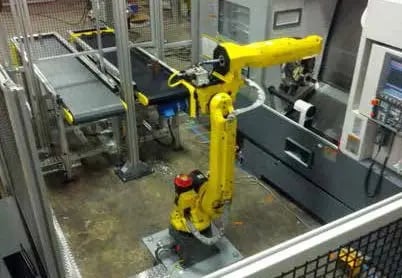
When evaluating an application, consider whether:Automated robotic solution with conveyor belts
  • Machine tools and fixturing are automation-capable
  • Machine tools are dedicated to specific parts or part families
  • Part families share common machining processes
  • Customers place repeat orders
  • Machining processes are stable or controllable
  • Production is slowed by operator intervention
  • Machine tools are not fully utilized
  • Part quality is affected by manual handling or operator variation

Many successful lights-out applications involve grinders, horizontal and vertical machining centers, multi-function lathes, and 2-axis or 4-axis lathes. To ensure the system holds accuracy throughout the lights-out period, many manufacturers use process control devices appropriate to the machine tools and applications. These may include jump-on gages, probes mounted in the machine tool, CMM (Coordinate Measuring Machines), and standard or custom automatic gaging systems.

AWR_TEXTURE_5

Real-World Examples of Lights-Out CNC Automation

The following case studies demonstrate how manufacturers have implemented automation to enable unattended production across various manufacturing applications. 

Automated Grinding Cell

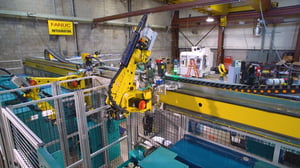
For this manufacturer of rotors used in air compressors, Gosiger Automation, now known as Automation Within Reach, incorporated an Okuma GA-47 grinder with a FANUC robot equipped with a vision system and adjustable grippers.

The Okuma grinder has a flexible, 2-axis configuration for greater versatility and handles parts up to 60” long, weighing as much as 660 lbs.

A specially designed chuck and adjustable grippers on the FANUC single-arm robot enable the cell to accommodate a variety of part sizes, each weighing up to 420 pounds. An integrated gauging system uses a probe to automatically adjust the grinder during operation, ensuring part accuracy and consistency. 

 The cell also includes a custom conveyor system that uses pallets of unfinished parts, loaded by a forklift.

 Another pallet receives the finished parts from the robot arm and, when completely loaded, is indexed out of the cell by the incoming pallet of unfinished parts. As a result, the cycle time for the operation is reduced by 62%, from 45 minutes to 16.8 minutes, and the operation now runs unattended overnight. 


Vision System Lets Robot “See” During Lights-Out Operation

Gosiger Automation combined an Okuma Multus B-300 CNC machining center with a Fanuc M-20iA six-axis industrial robot and a fixtureless conveyor system.

Steel slugs to be machined sit on the incoming conveyor, and the robot uses a vision system to locate, pick up, and load the parts into the machining center. At the end of the cycle, the robot arm removes the part and places it on the outgoing conveyor. As the Okuma lathe machines a part, the Fanuc robot uses its IRVision system to locate and pick up the next raw blank from the inbound parts conveyor for processing.

The lathe’s end-of-cycle signal queues the robot to open the machine door, load a part blank in the lathe’s sub-spindle, unload the finished part from the main spindle, close the machine door, and initiate a machine cycle start command.

For optimum efficiency, the finished part is deposited on the outbound conveyor by the robot as the machine tool produces a new part, and the next raw blank is picked up and staged. 

For the right lights-out plan, equipment selection, installation, training, and customer support, turn to Gosiger Automation, now Automation Within Reach. With over 90 years of machine tool experience and hundreds of successful automation installations, Automation Within Reach brings unmatched expertise to manufacturers of all sizes.
AWR-CUSTOM-EMERSON-12-WEB

Find the Right Path to Automation

From robotic machine tending to complete lights-out manufacturing cells, AWR helps manufacturers implement practical automation solutions that streamline production and support long-term growth.
