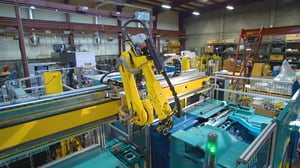
With their employees having to waste time on tasks not befitting their skills, Hy-Tech Machine Inc. decided the answer was to add automation to their operation. Alongside Okuma, Gosiger designed a system that helped Hy-Tech get the most out of its people, increasing efficiency and productivity.
Hy-Tech Machine Inc. struggled to find qualified laborers while existing workers were tied up with repetitive tasks, like loading and unloading parts.
![]()
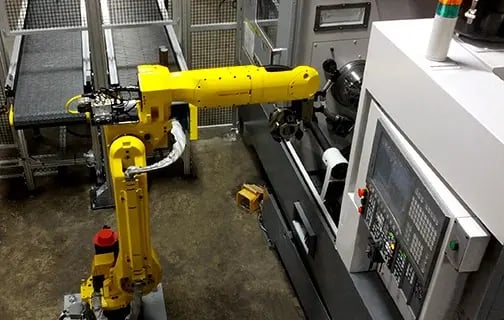
Integrated a CNC machine tending automation system with an Okuma Multus B300 and Fanuc M-20iA robot into its operations.
![]()
Accomplish lights-out manufacturing without adding headcount, while reducing cycle time from 32 minutes to 21 minutes on its largest volume part.
![]()
First Venture into Automation
Introducing robotic-based automation to a 90-year-old company that places a high value on the talents of its long-time employees was a big step for Bob Ober and Pittsburgh, PA-based Hy-Tech Machine Inc. “We have 60 hard-working employees performing turning, milling, and grinding operations on 38 CNC machines,” Bob explains, “and they all do a great job.”
However, it’s increasingly difficult to find qualified people to add to our staff. Meanwhile, our machine operators were bogged down with material handling, part loading and unloading, and other tasks that were not the best use of their skills. So we decided to investigate automating some of these procedures.”
Hy-Tech produces a comprehensive line of impact wrenches and other industrial-grade pneumatic tools, as well as replacement parts for many other brands. One aspect of the manufacturing process involves a family of 11 critical impact hammer components that Bob considered a good candidate for automation. He turned to his long-time Okuma CNC machine dealer, Morris Great Lakes, for a solution.
Morris consultant John Rodgers recommended an Okuma Multus machining center and brought in Gosiger Automation, the authorized systems integrator for Okuma America, to design the robot-based system.
According to Mr. Ober:
“Adding this automation system was a big investment for a company of our size, so we had to make sure we worked with someone who would listen to what we needed and then come up with the right approach.
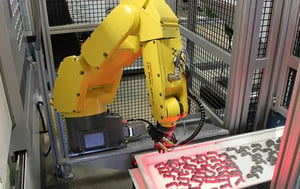
Gosiger Automation came through with a simple plan that combines the flexible and multifunctional Okuma Multus B-300 CNC machining center, with a Fanuc M-20iA six-axis industrial robot, and a fixtureless conveyor system. The steel slugs we machine sit on the incoming
conveyor and the robot uses a vision system to locate and then pick up and load the parts into the machining center. At the end of the cycle, the robot arm removes the part and places it on the outgoing conveyor.”
Gosiger Automation Explains Further
“We positioned the robot directly in front of the machining center while allowing the operator ergonomically correct access to the machine tool, and surrounded the robot work area with interlocked perimeter guards to ensure worker safety. Because of the amount of material removed from the part during the machining process, we equipped the robot with a dual gripping system to enable it to reliably handle the part both before and after each machining cycle.”
The Robotic Automation Works Like This:
As the Okuma lathe machines a part, the Fanuc robot uses its IRVision system to locate and pick up the next raw blank from the inbound parts conveyor for processing. The lathe’s end-of-cycle signal queues the robot to open the machine door, load a part blank in the lathe’s sub-spindle, unload the finished part from the main spindle, close the machine door, and initiate a machine cycle start command.
For optimum efficiency the finished part is deposited on the outbound conveyor by the robot as the machine tool produces a new part, and the next raw blank is picked up and staged.

“Gosiger Automation spent the time to really understand our needs. They came up with a design that made sense and then took us every step of the way through parts runoff, installation and training. Both Gosiger and Morris have provided excellent support throughout.”
The Robotic Automation Works Like This:
As the Okuma lathe machines a part, the Fanuc robot uses its IRVision system to locate and pick up the next raw blank from the inbound parts conveyor for processing. The lathe’s end-of-cycle signal queues the robot to open the machine door, load a part blank in the lathe’s sub-spindle, unload the finished part from the main spindle, close the machine door, and initiate a machine cycle start command.
Explore Our CNC Automation Solutions
Maximize your CNC potential with AWR's comprehensive machine tending automation. Our automation systems eliminate production bottlenecks across lathe and mill operations, delivering consistent quality and reliability that drive manufacturing success.
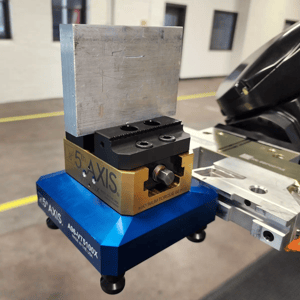
The AWR Flex Series delivers practical automation solutions for manufacturers looking to improve throughput and reduce cost per part. Built for single CNC lathes and mills, our DC and RCX systems simplify machine loading and unloading, minimize costly downtime, and help make better use of skilled labor — so teams can implement automation quickly and see measurable gains sooner.
Simplify
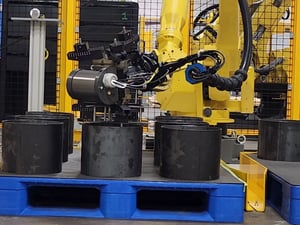
The Plus Series delivers automation without compromise—combining the speed of pre-engineered solutions with the precision of custom applications. Our proven Pallet, Drawer, and Conveyor options provide 80% complete automation foundations, enabling rapid implementation while maintaining the flexibility for specialized end-of-arm tooling that meets exacting manufacturing specifications.
Refine
When production challenges demand solutions beyond standard automation, AWR's Custom Integration Solutions provide the engineering expertise to transform complexity into operational excellence. Our comprehensive approach addresses unique manufacturing requirements through fully tailored systems—designed, built, and tested—to optimize multi-step processes and specialized applications.
Craft