Skip to content
AWR_TEXTURE_7

CNC Machine Tending: Part Handling Methods Explained

End-of-arm tooling (EoAT) plays a critical role in CNC machine tending, but the real decision isn't about choosing a gripper. It's about selecting the right part handling strategy for your machines, parts, and production mix. The wrong strategy costs you uptime, flexibility, and operator confidence. The right one runs lights-out.

This guide breaks down the primary EoAT and part handling strategies used in AWR's robotic machine tending and explains how to choose the right approach for your operation.

What Is End-of-Arm Tooling (EoAT) in CNC Machine Tending?

EoAT, or end-of-arm tooling, refers to the tooling mounted to the end of the robot arm that interacts with parts during CNC machine tending. This includes grippers, workholding interfaces, pallet-engagement features, and any tooling that enables the robot to pick, move, orient, and place parts.

The image shows a graphic icon of a robotic arm holding a cylindrical-shaped part within a dark circle.
Load and unload consistency
Icon of a clock within a circle. The clock face is white with a grey border outlined in a darker tone with orange rectangular shapes to showcase speed lines.

Changeover time between jobs

Icon of a robot's square face inside a circle. The robot's face has a line dash indicating no robots.
Manual input
Icon with a central orange gear containing a white star. To the right of the gear, there is a white checkmark inside a grey circle. The icon is enclosed within a larger grey circle with a thick border.
Run-time reliability

Since end-of-arm tooling is responsible for every physical interaction between the robot and the part, it plays a major role in overall automation performance. Poor EoAT choices can limit flexibility or introduce unnecessary complexity, while the right approach simplifies daily operation and supports long-term production goals. 

How Part Handling Strategy Impacts CNC Automation Performance

In many automation conversations, end-of-arm tooling gets boiled down to a single choice: "Which gripper should we use?" In reality, successful CNC machine tending is defined by the entire part-handling strategy —  how parts move through the process from first touch to finished piece, not just how the robot picks them up.

Looking at EoAT through the lens of overall part-handling strategy helps manufacturers make smarter decisions and explains why different machine tending platforms use different approaches. The right solution protects uptime, drives consistent results, and stays simple to run your parts, programs, and volumes evolve.

Part handling solutions define:

  • Whether the robot grips the part directly or grips the workholding
  • How parts are located and oriented
  • Where flexibility lives — in tooling, fixtures, or pallets
  • How easily production adapts as part mixes change
AWR-FLEXSERIES-DC-PNEUMATICGRIPPERS-CLOSEUP-250x250-WEB
Pneumatic Grippers
The image shows a close-up of a robotic arm with a yellow-colored end-of-arm tooling that appears to be electrically gripping an object.
Electric Part Handling
AWR-FLEXSERIES-RCX-MULTIGRIPINMACHINE-01-250x250-WEB
MultiGrip™ Workholding
AWR-FLEXSERIES-RCXPALLET-5THAXIS-03-250x250-web
Pallet Workholding
Direct Part Grip

Robotic Gripper-Based Part Handling

Gripper-based automation is the most common approach in CNC machine tending. In these systems, the robot grips the part itself and transfers it between storage, the machine, and downstream processes. This strategy works best when parts can be securely gripped and positioned without relying on external fixtures or pallets.

Pneumatic Grippers for CNC Machine Tending Robots

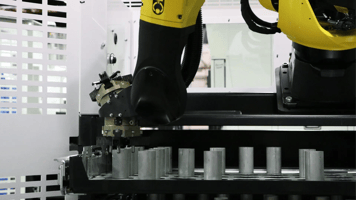
Pneumatic grippers have been used in CNC automation for decades. They're widely understood across manufacturing environments that rely on compressed air to open and close jaws.

Pneumatic grippers are a strong fit when:

  • Parts are consistent in size and geometry
  • Production runs are repetitive
  • Changeovers are infrequent
  • Simplicity is the primary goal
The image depicts a yellow-and-black robotic arm equipped with a gripper interacting with a series of silver cylindrical objects on a machine unit.

Typical use case: Job shops or production facilities running long, dedicated runs of a small number of similar part families.

However, in high-mix environments, pneumatic grippers can introduce additional setup steps when parts change. Mechanical adjustments, finger swaps, and manual turning can increase operator involvement and slow transitions between jobs.

Electric Grippers for CNC Automation: Flexible Part Handling

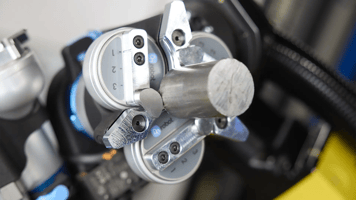
Electric grippers represent an evolution of gripper-based part handling. Rather than relying on air pressure and mechanical adjustment, electric EoAT enables digital control of grip behavior: force, stroke, and position are set in software rather than manually on the floor.

Close-up of an end-of-arm tooling. An electric gripper holding a raw cylindrical part on the end of an industrial robotic arm.


In CNC machine tending, electric part handling supports:

  • Faster transitions between different part geometries
  • More consistent grip behavior across jobs
  • Simplified setup for operators
  • Reduced part marking on finished surfaces

Typical use case: High-mix lathe environments where operators regularly switch between part families and need a single gripper that adapts without manual intervention.

For high-mix lathe environments, this flexibility simplifies daily operation. That's why AWR standardized on an electric part-handling solution for the Flex Series DC. It consistently supports a wider range of parts while keeping the operation simple for operators.

Gripping the Fixture, Not the Part

Workholding-Based Part Handling

In some CNC applications, particularly milling, the robot doesn't need to grip the part directly. Instead, it grips the workholding that secures the part. This approach shifts part handling from gripping variable geometry to gripping repeatable, consistent features.

RCX MultiGrip™ Workholding-Based Automation for Milling

The Flex Series RCX MultiGrip™ system is designed around gripping the workholding rather than the part itself. By picking and placing the jaw set, the unit maintains consistent orientation across multiple operations and handles complex part geometries without constant end-of-arm tooling changes.

Workholding-based part handling is especially effective when:

  • Parts vary significantly in shape
  • Multiple machining operations (OP10/OP20/OP30) are required
  • Orientation and repeatability are critical
  • You need to run up to four different part types without EoAT changes
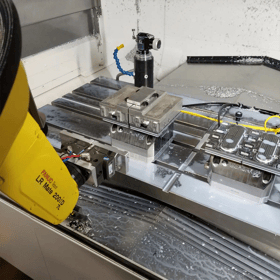
AWR-FLEXSERIES-RCX-MULTIGRIPINMACHINE-01-RESIZED-WEB

Typical use case: Mid-size milling operations managing a rotating mix of part geometries where swapping EoAT between jobs would add unacceptable downtime.

By allowing the workholding to define the process, the AWR RCX MultiGrip™ expands what you can confidently automate while keeping setup predictable and repeatable in demanding milling environments.

Pallet-Based Machine Tending: Repeatability & Flexibility

Pallet-based part handling takes a fundamentally different approach to CNC machine tending. Instead of asking the robot gripper to adapt to every part variation, pallet automation drives consistency and reliability into the workholding and pallet interface itself.

In a pallet-based system, the robot's role is straightforward: move, place, and manage pallets. It's not constantly adapting to changing part geometry every cycle. This strategy is especially powerful in milling applications where orientation, repeatability, and process stability matter more than per-part flexibility.

Omni Pallets — Flexible Pallet Fixturing for High-Mix CNC

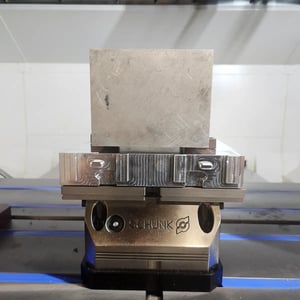
The AWR Flex Series RCX Omni Pallet is an open-architecture pallet platform engineered for maximum flexibility. Rather than locking you into a fixed mounting pattern, it’s designed to accept virtually any part geometry and mounting strategy, so you decide how parts are fixtured, not the pallet.

Parts can be bolted, clamped, pinned, or otherwise secured directly to the pallet surface, regardless of shape or orientation. This gives your team the freedom to adapt fixturing to the work, while the automation cell continues to run with a consistent, repeatable pallet workflow.

A precision metal base mounted in a machine vise, designed to hold and locate parts in a consistent position. This pallet fixture allows parts to be securely placed, removed, and reinstalled with high accuracy for repeatable CNC machining.

Omni Pallets are a strong fit when:

  • Parts vary significantly in shape or size
  • Fixturing needs to be highly customized
  • You need flexibility at the pallet level rather than in the end-of-arm tooling
  • You're entering pallet-based automation for the first time and want an adaptable starting point

Typical use case: Contract manufacturers or job shops with a broad, evolving part mix who want pallet-level automation without being forced into a rigid fixture standard.

Pallet Cleat — High-Repeatability Automation for Long Unattended Runs

The AWR RCX Pallet Cleat system is a rigid, production-ready pallet platform engineered to remove variability from your process. Using a proven 96 mm pull-stud interface, parts are locked into a mechanically defined, repeatable position every cycle.

With pallet cleats, operators manually clamp parts into a 5th Axis vise  (compatible with other 96mm pallet brands) mounted on a standardized pallet interface, so each part enters the cell in the exact same position on every load. The result: minimal cycle-to-cycle variation and a more stable machining process.

Pallet Cleat is the right choice when:

  • Long, unattended overnight runs are the goal
  • Tight tolerances demand consistent part location every cycle
  • Process stability matters more than fixturing flexibility
  • You're running production volumes where predictable, high-quality output is non-negotiable
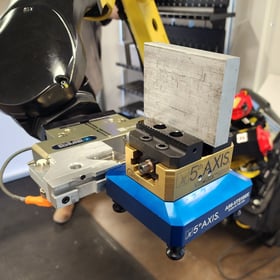
RCX-Pallet_5Axis

Typical use case: Aerospace, defense, or precision manufacturing environments where part location certainty is critical and runs long enough to justify structured fixturing.

How to Choose the Right Part Handling Solution for Your CNC Operation

The right EoAT and part-handling strategy depend on four key factors: your part mix, your machine type, your tolerance for operator involvement, and how often production changes. Use the table below as a starting framework.
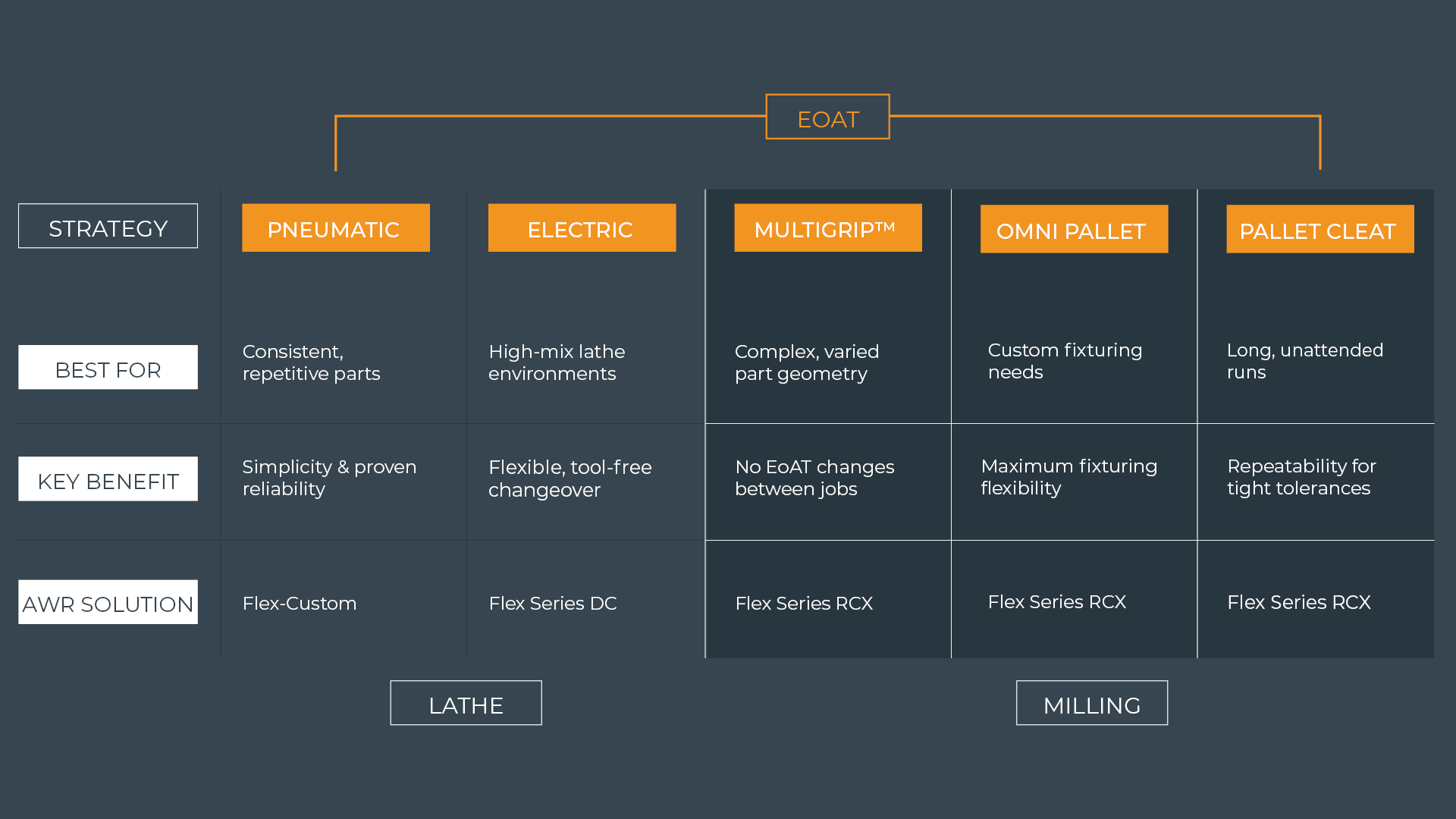
AWR EOAT GRAPHIC

A few guiding questions to help narrow your decision:

  • Do your parts vary significantly in geometry? If yes, workholding-based strategies reduce EoAT changeovers.
  • Is your primary machine a lathe or mill? Lathe tending most often uses gripper-based EoAT; milling tends towards workholding or pallets.
  • How long are your production runs? Short runs favor flexibility (electric gripper or Omni Pallet); long runs favor repeatability (Pallet Cleat).
  • How much operator involvement is required? Pallet systems minimize touchpoints during runs, while gripper-based units may require more intervention at changeover.

Frequently Asked Questions: EoAT Part Handling for CNC Machine Tending

What is end-of-arm tooling (EoAT) in robotic machine tending? EoAT refers to all tooling mounted to the end of a robot arm that physically interacts with parts during machine tending. This includes grippers, workholding interfaces, pallet-engagement features, and any other features that enable the robot to pick, move, orient, and place raw and finished parts.
What's the difference between EoAT and workholding? EoAT is mounted on the robot and moves with it. Workholding is mounted on the machine and holds the part during machining. In workholding-based part-handling strategies, the robot grips the workholding itself rather than the part, combining both concepts into a single interface.
Can one gripper handle multiple part sizes? It depends on the gripper type. Penumatic grippers typically require mechanical adjustment or finger swaps between different part families. Electric grippers adjust grip force and stroke digitally, allowing a single gripper to handle a wider range of geometries without manual intervention.
When does workholding-based automation make more sense than gripper-based automation? Workholding automation is a stronger fit when part geometry varies significantly, when multiple machine operations (OP10/OP20/OP30) are required, or when unattended overnight runs demand maximum repeatability. If your primary challenge is flexibility across part families rather than per-part grip variation, a workholding-based solution provides a more stable foundation.
What is the ROI of robotic CNC machine tending? ROI depends on factors such as labor costs, shift length, part volumes, and scrap rates. Generally, robotic tending enables continuous operation beyond human shifts, reduces load/unload variability, and lowers the per-part labor cost over time. Most manufacturers evaluate payback in terms of increased spindle utilization and reduced operator involvement per machine.
How much operator involvement is necessary with automated machine tending? This varies depending on the end-of-arm tooling and part-handling solution. Gripper-based units in high-mix environments may require a technician's interaction during job changeovers. Workholding-based automation systems are designed to reduce operator touch points during production runs.
AWR_TEXTURE_2

Interested in Finding the Best EoAT or Part Handling Solution for Your Manufacturing Production?

Connect with the AWR team to quickly identify the right end-of-arm tooling to optimize your CNC machine tending workflow without sacrificing quality or control.